
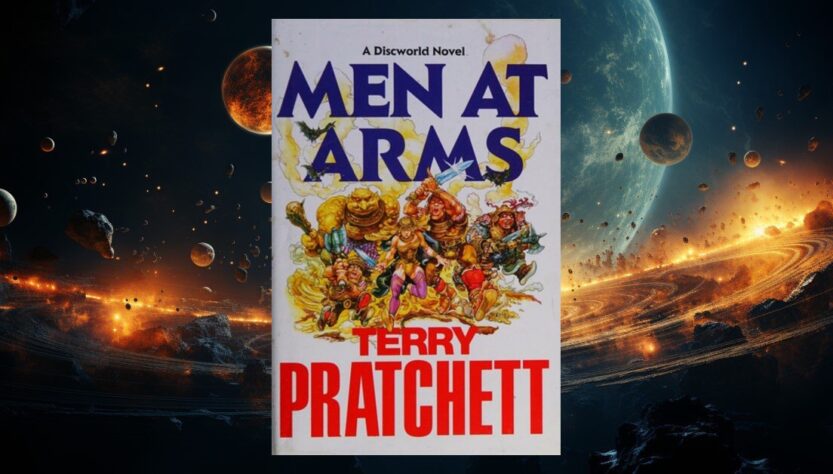
Review
If Guards! Guards! by Terry Pratchett was the book where the Watch arrived, Men at Arms is the one where Terry Pratchett works out exactly what he can do with them. This is still very funny, still packed with throwaway gags and absurd side business, but it is also tighter, sharper, and much more interested in how institutions work when the people inside them are barely holding the whole thing together with string, bad habits, and force of personality.
That matters because the Watch books live or die on whether you want to spend time with the squad, and here the roster expands in a way that instantly makes Ankh-Morpork feel bigger. Carrot is no longer just the earnest giant with a suspiciously obvious destiny hanging around him. Vimes is no longer only the cynical copper with a drink problem and a genius for knowing where the rot lives. The book starts giving them a proper ecosystem to bounce off, and once Cuddy, Detritus and Angua arrive, Pratchett suddenly has a whole new set of social fault lines, comic rhythms, and emotional gears to play with.
That mix is what makes the novel work so well. On one level, this is Pratchett taking the mickey out of fantasy's favourite old machinery, lost kings, magic weapons, destiny, the idea that some shiny bit of legend can solve the messy problems of an actual city. On another, it is a murder mystery with a very nasty invention sitting at the middle of it. On yet another, it is a story about what happens when an institution that has always been gloriously useless is forced to become slightly less useless in public. Pratchett makes all of that feel natural, which is harder than he makes it look.
Having read the whole City Watch run, this is also the point where you can feel the series discovering its real long-term strengths. Guards! Guards! is brilliant, and I still have it higher at five stars, but Men at Arms is arguably more important to what the Watch books become. This is where Vimes starts to lock into the version of himself that carries the later novels. It is where the books become more openly interested in class, prejudice, bureaucracy, power, and the ways a city teaches people what counts as normal. Pratchett never stops being funny while doing that, which is part of why he gets away with so much.
Vimes is particularly good here. He has always been one of Pratchett's best creations because he is both deeply competent and permanently irritated by the fact that the world insists on being run by idiots. This book leans into that beautifully. There is a lovely tension between the official story that ought to be unfolding around Carrot and the grubby reality Vimes understands instinctively. Pratchett knows exactly how much mileage there is in putting mythic fantasy expectations next to the practical needs of policing a city full of guilds, species grudges, and people who would absolutely steal the legend if you left it unattended for five minutes.
The supporting cast earns a lot of the book's goodwill too. Detritus and Cuddy are not just there for easy punchlines, even though Pratchett gets plenty of those. Angua arrives and immediately changes the chemistry of the group. Nobby and Colon remain deeply themselves, which is to say ridiculous, oddly useful, and always at risk of wandering into satire simply by existing. Even Gaspode, in brief appearances, helps give the whole thing that wonderfully grubby street-level feel the Watch books do better than any other Discworld strand.
What lifts Men at Arms above a lot of clever comic fantasy is that Pratchett never treats the satire as decoration. The species tensions are funny until they are not. The class politics are absurd until they hit something real. The joke is often the delivery mechanism for a point about who gets power, who is allowed to belong, and who gets told that the way things are is simply the natural order. Pratchett is far too smart, and far too angry in the right ways, to let those ideas sit in the background as mere texture.
I would still stop short of calling it one of the absolute top-rank Discworld novels, which is why four stars feels right rather than five. Parts of it are so strong that the slight bagginess elsewhere becomes more noticeable. The plot has a lot to carry, and now and then you can feel Pratchett enjoying the characters and ideas enough that the momentum loosens a touch. The jokes land, the themes land, the ending works, but there are stretches where the book feels more interested in everything around the central engine than in driving flat out through it.
That said, even Pratchett operating a fraction below his peak is still miles ahead of most people. The standard here is ridiculous. Compared with the broader chaos of Sourcery or the slightly less focused edges of some earlier Discworld books, this feels confident and assured. Compared with later Watch books like Night Watch, which hit harder emotionally and thematically, it looks a little like a brilliant series still warming up. That is not a criticism so much as a reminder of how absurdly good the run eventually becomes.
If you like fantasy that uses genre furniture to talk about real things without turning into homework, this is prime Terry Pratchett. If you like police procedurals but wish they contained dwarfs, trolls, civic decay, and arguments with destiny itself, even better. If you want a Discworld novel where the heart of the story is not just the gag density but the feeling that a found-family workplace might accidentally become something decent, this is one of the key books.
Men at Arms is not my favourite Watch novel, and it is not quite on the same level for me as Guards! Guards!, Mort, or Small Gods. What it is, though, is foundational. It is the book where the Watch becomes the Watch people remember, and where Pratchett starts using that corner of Discworld to do some of his richest, funniest, and most quietly pointed work. Four stars, comfortably, and with a lot of affection.
Rating: 4/5
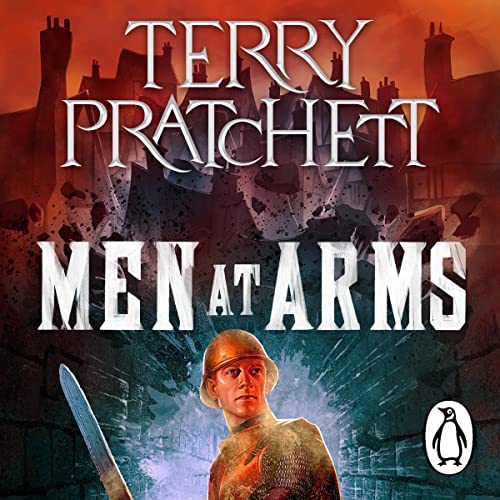
The Audible UK edition is narrated by Jon Culshaw, Peter Serafinowicz and Bill Nighy, and runs to 12 hrs and 58 mins.
Discover more from Unfolded Universe: Sci-Fi Book Reviews
Subscribe to get the latest posts sent to your email.